

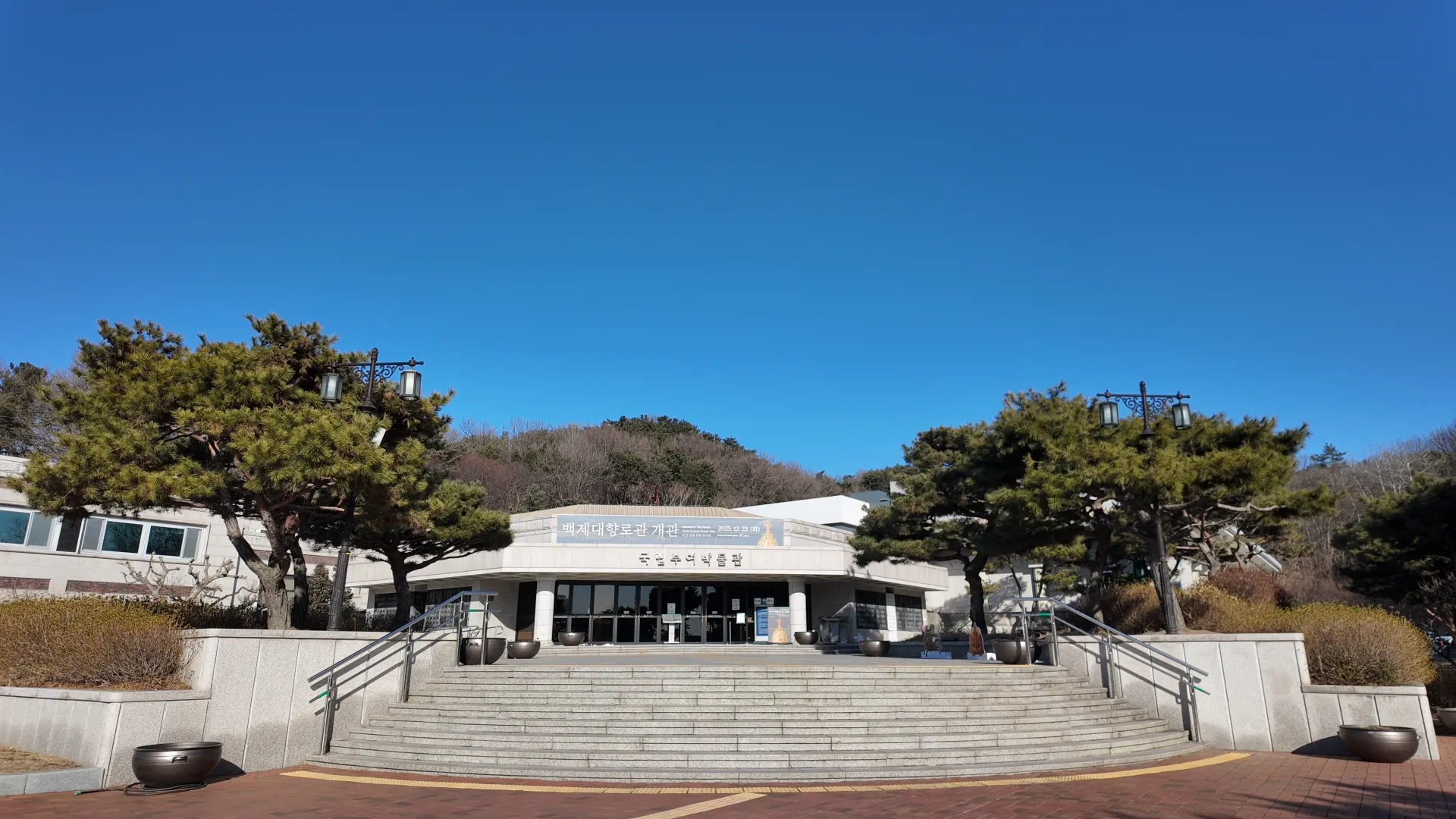
Buyeo National Museum is a museum well worth adding to your Buyeo itinerary. Its exhibitions focus on Baekje artifacts, making it a great place to understand the historical flow of Buyeo in one visit. The museum is located at 5 Geumseong-ro, Buyeo-eup, Buyeo-gun, Chungcheongnam-do.
The museum has a long history. According to the Korea Tourism Organization, it began in 1929 when the Buyeo Historic Preservation Society collected and displayed Baekje cultural properties and artifacts. It reopened at its current location on August 6, 1993.
Why Buyeo National Museum Is Special
The greatest strength of Buyeo National Museum is its strong focus on Baekje. According to the Korea Tourism Organization, the museum stands on a site of about 61,429㎡ and includes four exhibition halls and an outdoor exhibition area, displaying around 1,000 artifacts. The building itself was also designed to reflect traditional Korean architectural style.
The exhibition layout is also easy to follow. According to the museum’s official guide, there are Exhibition Halls 1, 2, and 3, a Donated Artifacts Gallery, and an outdoor exhibition area. Sabi Maru, which includes a performance hall and a children’s museum, is also operated together with the main museum.
Must-See Highlights at Buyeo National Museum
The most iconic artifact here is the Baekje Gilt-Bronze Incense Burner. The museum introduces it as an artifact discovered at the temple site in Neungsan-ri, Buyeo. Its composition is especially striking, with a phoenix, a mountain-shaped lid, a lotus-shaped body, and a dragon-shaped base.
There are many other important artifacts to see as well. According to the museum FAQ, national treasures currently on display include the Baekje Gilt-Bronze Incense Burner, the Stone Reliquary from Neungsan-ri Temple Site, the Gilt-Bronze Standing Avalokitesvara from Gyuam-ri, the reliquary set excavated from Wangheungsa Temple Site, and a bronze bell set formerly from Nonsan. Several treasures are also displayed together.
According to the official exhibition guide, Exhibition Hall 2 covers Sabi-period Baekje and the Baekje Gilt-Bronze Incense Burner, while Exhibition Hall 3 focuses on Baekje Buddhist culture. For that reason, it is better not to stop after seeing only the incense burner, but to also explore the broader flow of Sabi-period Baekje and Buddhist art.
Why Buyeo National Museum Is Worth Visiting in Buyeo
Buyeo has many historic sites such as Jeongnimsa Temple Site, Busosanseong Fortress, and the Neungsan-ri Tombs that are best appreciated in person. Buyeo National Museum is a great place to visit before or after seeing those sites, because the names and artifacts you encounter on-site connect again through the exhibitions.
If this is your first time in Buyeo, starting with the museum is a convenient route. After seeing the exhibitions first, it becomes much easier to understand what kind of capital city Sabi was in the Baekje period. That is why it is especially satisfying for travelers who want to enjoy a slower and deeper historical journey.
Immersive Content Worth Seeing
Buyeo National Museum is not only about traditional displays. The official guide also introduces a digital immersive media hall. With content that interprets the Baekje Gilt-Bronze Incense Burner and Baekje decorative bricks through light and video, it offers a more vivid way to experience the exhibition.
More recently, the Baekje Incense Burner Hall, a dedicated exhibition hall for the Baekje Gilt-Bronze Incense Burner, also opened. According to the museum’s official press release, this hall opened on December 23, 2025, and was designed to help visitors appreciate the incense burner more deeply through light, sound, and scent.
Visitor Information
Buyeo National Museum is open from 9:00 AM to 6:00 PM, Tuesday through Sunday. Last admission is at 5:30 PM. It is closed every Monday, on January 1, and on the day of Seollal and Chuseok. Admission is free.
The museum is not difficult to reach from central Buyeo, so it fits well into an itinerary together with Jeongnimsa Temple Site, Busosanseong Fortress, and the Neungsan-ri heritage area. However, special exhibitions, the children’s museum, and hands-on programs may operate differently, so checking the official website before visiting is recommended.
Conclusion
Buyeo National Museum is a place that helps visitors understand Buyeo’s Baekje heritage more deeply. Its strength lies not only in iconic artifacts such as the Baekje Gilt-Bronze Incense Burner, but also in presenting the broader flow of Sabi-period Baekje and Buddhist art in one place. If you want to see Buyeo in a more complete and layered way, this museum is well worth adding to your trip.

Leave a Reply
You must be logged in to post a comment.